Principal nurturing
self-motivated, actively engaged, life long learning and leadership through fun, authentic, innovative and collaborative experiences.
Coming together and sharing our learning is an important way to help parents understand how they can be supporting their children.
This year, all of our teachers and children have received professional development around Peer Tutoring. We have ben focussing on writing across the school through peered writing and the teachers have already seen remarkable improvements in more than just writing.
Peered tutoring raises children's awareness in social, emotional and academic skills as well. Research proves that when children support, challenge and give feedback to each other with learning, their progress and achievement excels. When peered tutoring takes place in a purposeful and planned manner with tutors and tutees receiving training, the results speak for themselves.
Thank you to Linda Schofield and Belinda Brosnan from the RTLB service for their support with this whole school project. Thanks to our teachers who enthusiastically shared their experiences with families at our Family Learning Hui. Thanks to the children and families who came to the hui. You can gain insights into how peered writing works and learn about what we shared at the hui by watching the following short videos.
There are still a few videos of the learners in action to upload.
When we transformed our teaching and learning environment into ELS's in 2015 in response to our community focus "To engage every learner in deep learning for success", we began to operate within an authentic, living inquiry of practise. We naturally moved away from the individual class "teaching as inquiry" model to a collaborative holistic whole school inquiry. Our adaptations to our ELS's during the first year were based on learner, staff and parent surveys, videos, reflections, observations, discussions and professional readings. We were and still are open to learning and change in order to create an environment conducive to the best outcomes for all learners within our community. We believe our environment is organic and reflects the environment referred to in a video developed for the Learning and Change Strategy in 2014 where "self organising living systems have the capacity to respond to change".
Some recent work with the MOE drew my attention to the "Spiral of inquiry". You can read a succinct account of the paper entitled A Framework for transforming learning in schools: Innovation and the spiral of inquiry written by Timperley, Kaser & Halbert (2014) on the MOE Educational Leaders site at this link.
Spiral of Inquiry Source: Timperley et al, 2014
Here are my own thoughts around this framework for leading authentic learning in the context of our ELS's.
The
new framework involves learners, families and communities and a shift from
student voice to learner agency (p5).
Our ELS model seeks feedback from all
involved. We aim for learner agency but need to keep refocusing on this in
practice.
A
mindset of curiosity and genuine inquiry into what is going on for learners
is vital and leads to hunches (p5,6).
We have to continually remind ourselves
to be open to change and be willing to action this.
It
is a collaborative process and involves a highly motivated and energetic
team (p6).
In 2015 we moved away from single
teachers making decisions around teaching, learning and evaluation to the
ownership belonging to energetic, inquiring teams.
It
is grounded in OECD emerging knowledge and reflects the 7 principles of
learning (p5).
We incorporate the 7 principles of
learning naturally. We need to specifically relate to these.
It
is ongoing inquiry of learning leading to innovative action (p6).
This is how we operate naturally within
our school wide ELS’s.
Any
change needs to involve working out what will work in the context of your own
environment (p6).
As a Catholic school we are aware of
ensuring the context of our environment reflects holistic innovation.
Continually checking what is working and
not working well is essential (p6).
We do this across teams and as a whole
team and involve all members of our community. Video evidence recorded on
blogs grounds our practice.
Box 2 on page 8 of the framework has questions related to each of the 7 principles of learning.
In the different phases of the spiral, trust and engaging learners and their families are a recurring theme. Here is a brief summary about each phase of the spiral: Scanning (p7- 9): This is about digging deeper, going underneath the data to get an understanding of the experiences of learners to drive change. Teacher observations and surveys of social, intellectual and emotional engagement are valuable. Using the questions in Box 2(p8) of the principles helps to get a bigger picture for the learners. Focusing (p10-11): This is determining which area to concentrate on to start to make a difference. It's about asking the question - What's going on and how do we know ? It's about talking with the learners too and identifying a common area many people can buy into. Developing a hunch (p12-14): Intuition and hunches, together with evidence, inform scanning and guide focusing. We all take responsibility for the areas we have influence and control in and have the confidence to share ideas where it is safe to question our own behaviours and beliefs. Checking assumptions for accuracy is important before moving ahead. New learning (p14-16): Motivated by and connected to changing the learning experiences of learners and understanding why new ways of doing things are better than previous practices. Supporting and sustaining learning over time. Taking action (p17-19): Informed actions. Learning more deeply about new ways of doing things, informed by a deep understanding of why new practices are more effective than others. Evaluating the impact on learners. Checking (p19-21): Have we made enough of a difference as a team? Evidence seeking about high expectations. Providing information on the impact of actions and setting the stage for what will come next.
This process is based on a rich understanding of what is going on for learners. Success with small change leads to more radical changes and transformation takes place. Evidence - informed, systematic inquiry becomes a professional way of life as one inquiry leads to another within the spiral. A shared collaborative inquiry approach provides coherence within schools and across schools and is recognised as curiosity- driven change.
Applying the phases of the spiral to our ELS's at St Joseph's in 2016 will provide coherence to our existing living inquiry. We will be able to refocus our school wide inquiry process around a recognised framework for transforming learning and continue to innovate our practise to meet the diverse and challenging needs of all learners.
visioning day led by Mary Wilson. You can read about the day in this post: "How often do we think deeply about what we are doing? A purposeful visioning process Part 1" at this link.
Special thanks to Teresa Edwards, principal from St James Catholic School in Palmerston North and a member of the NZCPPA, who facilitated the next part of the process with the NZCPPA Executive in Taupo.
Teresa reminded us that we were on a shared visioning journey and described the process we went through last time. Our initial goal was around clarity as an organisation. She explained we would review the shared vision from the first session and unpack the core values and plan our follow up actions. Teresa also shared the importance of every voice being heard "we all have personal and practical knowledge to contribute". As with the first session, the use of the robust and fair classic brainstorming and 10/4 consensus voting process meant every voice did get heard.
New Zealand Catholic Primary Principals Association Exec
Shared vision - Our picture of the future we want to create
Below is the vision statement, the outcome of the collaborated work from the Part 1 Visioning Day. We shared our personal reflections on the vision. Teresa then asked us to apply the traffic light system to our personal reflections.
Applying the traffic lights 1:36 sec
PURPOSE/Vision
The purpose of the Association is to assist Principals to advance education for the benefit of the public at Catholic Primary Schools Aotearoa New Zealand.
How we enact our Purpose/Vision
We have an agreed and shared understanding of our Catholic ethos.
We are informed and keep the Catholic ethos in the forefront of our thinking in relation to the current issues and debate.
We consistently articulate this in all that we do and say.
We are fully conversant and informed about the principles of Catholic social teaching and justice.
As the NZCPPA executive we ensure our time together throughout the year is used for its maximum impact.
Robust discussions and debates are always first on the agenda.
We use tools that encourage robust dialogue and help with collaborative decision-making around big issues.
Agendas are clear and concise.
Meetings are run efficiently with balance to ensure issues are discussed and resolved in a timely manner.
To allow the exec to be well informed we continue to invite guest speakers. Meeting times are structured with regular breaks and visits to Catholic Schools.
We continually review the most effective ways to connect with our principals to ensure we clearly communicate and consult.
We use the online environment when appropriate.
We listen to our members.
We have a clear structure to be effective in distributing and collecting information.
We have a constitution to clarify what we believe and how we operate as an executive.
Exec members have regular communication with local principals formally and informally and ask for a set agenda slot at all local principal meetings.
The NZCPPA website is promoted across NZ and is a one stop, purposeful, ‘go to’ place to provide strength and vision for all.
As the NZCPPA exec we Identify roles and responsibilities needed and gain clarity of responsibility for each member, including their ongoing role between meetings.
These roles are clearly defined including a clear structure for allocation of tasks.
Members of the exec have a clear job description of their role and responsibilities to ensure consistency of practice across NZ.
There is allocated time to work on our areas of responsibility at each meeting. An annual plan of actions is identified to ensure strategic goals are covered effectively and purposefully.
This plan is reviewed at each quarterly meeting.
As an exec we operate effectively as a team being an active and informed voice for the Catholic Primary Principals of New Zealand.
The Executive discussed about including the one sentence statement from the NZCPPA constitution at the top of this Vision. The next step was to unpack the core values. These would then guide our actions and contribute to a strategic plan for going forward.
The what and the how of the visioning process 1:18
Classic Brainstorming and 10/4 voting 2:38 sec
Moving from vision to actions: Unpacking the core values 4:22 sec
NZCPPA Exec member shard at work following the classic brainstorming process
Group consensus work around the core value :We value decision making that reflects our Catholic ethos.
Teresa reminded us to reflect on this slide as we worked our way through this robust process.
Know the strengths of the group 0.57 sec
Some Key Reminders from Teresa:
It doesn't matter who comes and goes, the vision will still be there. It is the shared vision that was created for the school or the organisation.
Trust the process. It's important.
The Core values are the things we do to make the vision come alive and happen
Next steps:
The group began to work on a shared collaborative document to turn the vision into action. This will become an action plan for future meetings.
The Otago Southland Catholic Primary Principal Association (OSCPPA) are going to work through a similar process as a way to strengthen leadership and networking capability for Catholic principals within the Dunedin Diocese.
Special thanks to Teresa Edwards for allowing me to publish these videos and to the NZCPPA for their transparency around these dynamic visioning days. The NZCPPA are modelling equitable and robust processes and practices for Catholic principals, associations and schools across New Zealand.
Action without vision is only passing time, vision without action is merely daydreaming, but vision with action can change the world.
I recall how excited my colleagues and I were when we spotted the giant 'hub' sign in the domestic terminal at Christchurch Airport. We were on our way to attend the Catholic Education Convention in Wellington and were transferring to another flight. The giant, illuminated sign generated a rich discussion around the benefits of our new learning spaces.
Hub at Christchurch Airport, New Zealand
At the start of 2015, we welcomed families into our Engaging Learning Spaces (ELS). Our traditional classrooms were creatively transformed into collaborative, engaging learning spaces.
To help children, staff and parents understand the collaborative nature of these ELS, we introduced the word 'hub' to replace the word 'classroom'. Most dictionaries define a 'hub' as 'a centre of activity'. Different schools have adopted different names such as pods, caves, hubs and hives. We settled for hubs: Junior Hub 1 ( NE, Yr 1), Junior Hub 2 ( Yr 2, Yr 3), Senior Hub 1 ( Yr 4, Yr 5), Senior Hub 2 ( Yr 6, Yr 7, Yr 8)
It's important to understand the word hub refers to the physical location of the classes. Classes are not mixed together in the hubs like the traditional composite model. Year groups still maintain their unique identity with a dedicated year group teacher.
The word 'hub' does not define the way we plan or teach. It is a way to locate year groups across the school, just like the convenience store at the airport. The way we plan and teach can be more readily described by the word 'collaborative'.
I am fortunate to have experienced teaching in a range of settings and countries for thirty-five years. During that time, I have been part of traditional, open plan, montessori and jena plan classrooms and schools. Each worked in its own way and addressed the learning needs for the learners at the time. The one constant that made all of these learning environments successful, was enthusiastic and passionate educators, focussed on achievement and success for all.
Our curriculum goal for several years has been: To engage our learners in deep learning for success. During this time, we dedicated time to inquiring into our teaching practice, talking with our learners and studying research around engagement. This theme was the focus of my sabbatical study in 2014.We are a team of professionals. When we come together as a collaborative team and genuinely discuss how to make a positive difference for the children we teach, we bring together our combined experience and expertise. For example, if we combine the teaching experience of all of our teachers, we share 200 years of experience. Imagine the rich, educational discussions we have when we come together. Similarly, when two teachers combine their knowledge and expertise, they enrich the teaching and learning opportunities for the learners in the ELS.
Five simple ways parents can support teachers
As parents and first educators for children, teachers need parent's support.
1.Take time to explore the Teaching and Learning site with your children. Our teachers have willingly shared their planning.
2. Be purposeful and positive about actioning the ways you can support your children and ask your child or their teacher if you can't understand anything.
3. Help your children to get to school well before 9 o'clock so they can settle and prepare for the day ahead.
4. Smile and show you appreciate the efforts your child's teachers make. Children can sense negativity and thrive in a positive, loving environment. Our teachers are all passionate about teaching and we want them to share their love for learning with your children.
5. Make time to have a chat with your child's teacher if you have any worries. It's better to arrange a dedicated time when the teacher is free. We like our teachers to be in hubs, mingling with the children, relationship building between 8:30-9:00.
To hub or not to hub. It's time for parents to move the focus from the 'hub' and to genuinely engage with the authentic learning opportunities available for children in the ELS. In 2016, we are already moving from engagement to empowerment for our learners. Let's all be empowered as we work together to help our children succeed to be the best they can be in all they do.
In 2014, we began to share our learning, news and events digitally. In 2015, we transformed our learning spaces (Engaging Learning Spaces ELS learn more here) to reflect our school wide goal: To engage every student in deep learning for success. We continued to share our learning via blogs and a dedicated Teaching and Learning Site.
Our popular weekly school newsblog has had over 45,000 views from learners, families and interested visitors across the world.
We also welcomed over one hundred visitors to our school in 2015. You can learn more at this link. Principals and teachers from across the South Island described our students as "...engaged and connected learners who could speak confidently about their learning". You can learn more about 2015 and next steps for 2016 at this link.
Here is a video taken during one of the visits.
We received a glowing Catholic review report. You can learn more at this link. We are committed to continuing to keep Christ at the heart of all we do at St Joseph's as we strive to honour the reason for the existence of our Catholic schools.
Here are 5 key reminders for the 2016 new school year:
1. School starts back on Monday 1st February. The uniform shop will be open on Wednesday 27th January and Friday 29th January from 9:15-12:30pm. It will also be open on Monday 1st February from 8:30-9:00. Thanks Adele for being available. 2. Our 2016 stationery lists can be found at this link. You can order them online through Office Max or take the list to our local Paper Plus or Warehouse store and collect what you need. 3. The Home & School with funding support from the board and the Otago Community Trust are generously upgrading the hall kitchen. There will be no school canteen in Term 1. Lunch options will be shared with you next week. Children will need to bring their own lunches during the first week of term. 4. On Thursday 4th February at 9:15am there will be a welcome back school mass followed by the presentation of badges to our Year 8 leaders in St Patrick's Basilica. All parents and friends are welcome to join us.
5. Our dedicated 'Teaching and Learning Site' will be updated and ready to go for 2016 before the new school year begins. You can check what's happening in the first week of the term by going to the section for your child's year group at 5pm on Sunday 31st January. Take some time to help prepare your child for school by discussing the learning together.
Thanks to our board who have funded the installation of three air conditioning units for the upstairs ELS. These will help to provide some much needed cool air for our Senior Hub 2 learners and staff.
At the request of the School Council, the board have also funded a new water fountain where drink bottles can be easily filled up. A new uniform shop is also under construction and we are waiting for the new basketball hoops to arrive.
Thanks to all of our staff including cleaners, caretakers and office staff who have spent time preparing our school to officially welcome you back on Monday.
Please contact us if you have any questions, worries or concerns by emailing office@stjoseph.school.nz or jjackson@stjoseph.school.nz or by ringing 03 4348856. Like us on our school Facebook page St Joseph's Oamaru or follow us on Twitter and Instagram by typing in #Stjoesoamaru. You can also check up on any information on our newsblog or school website and download the PTC calendar app on your phone.
We look forward to welcoming you all back to St Joseph's for the 2016 school year as we continue to Reach for the Stars as Lifelong Learners in the Catholic Faith.
"Close your eyes while I read the first draft of your vision..." After seven hours of deep thinking, classic brainstorming and 10/4 voting, I closed my eyes along with fifteen fellow principals. While our inspirational facilitator slowly read through the one page draft vision document, I immediately felt a sense of connection and empowerment. I was not alone. Everyone of us in the room could hear our voice and our words reflected in this authentic document that is the first draft of the guiding light for the New Zealand Catholic Primary Principal's Association (NZCPPA). Along with agreed values, it was the articulation of actions that immediately brought the vision to life.
Being an active participant and contributor during the NZCPPA Visioning Day in Auckland was a privilege. Starting the day at 8:30 am and having the first draft of an authentic vision ready to review by 3:30pm was made possible by the purposefully planned work of our skilled facilitator and principal Mary Wilson.
Here are my notes and photos of slides from this powerful experience. I believe they capture the essence of the day and will be a guide for reflection for fellow principals and leaders: Visioning can come about in three ways - telling, consulting and co creation. Co creation is the model that works and the model we used with Mary. She explained that many principals find co creation the hardest as they aren't involved. Instead they are gifted with a one page vision that will truly belong to the community. It is an authentic living document. The principal becomes the caretaker of the vision and then promotes and actions it.
Principals at work during the visioning process
As an executive association who meet for only twelve days per year, it is important to ensure time together is maximised. Probe inquiry questions (deep and specific questions) are prepared by the facilitator in relation to all documents connected with the school or business (eg. school website, prospectus). An organisation might be given seventy probes as an outcome of exploring the key documents and then they are narrowed down to eight to ten questions to be used over two days. The NZCPPA have a specific and global job and four probes suited the one day session. These were the probe questions taken from potentially ten questions based on the literature from the NZCPPA:
What must we do to ensure we initiate and participate in educational debate and policy development reflecting our Catholic ethos ?
What systems and structures do we need to provide a collective voice for Catholic principals at national level ?
What systems and structures do we need to ensure our time together throughout the year is used for its maximum impact in leading the NZCPPA ?
What are the most effective ways to communicate with our principals to ensure we clearly communicate and consult ?
Classic brainstorming,10/4 voting and the 'golden rule' of no discussion enable the day to be a purposeful 'idea generation' day. This is exactly what it was. Classic Brainstorming The recorder or leader of the group writes down verbatim what each person says in response to the probe question. You can pass but there can be no discussion. Everyone in the group gets a chance to respond and you keep going round the group. The questions and the responses are all numbered. The next step is to ask if anything needs to be clarified and the person who owns the response can give one explanation. Then the leader asks the group if any of the responses are the same or similar and these can be linked together (with affirmation from the responders).
10/4 voting Mary believes this is the best consensus tool. Everyone has ten votes and can only spend ten votes in any one round. These are recorded by tally marks and the recorder gets a chance to vote too. The next step is to calculate and circle the top three responses from the group. People end up having deep thought because they can't get into discussion. Each group follows the same process and the top three responses are collated into a new document. Everyone then gets a chance to have a final private vote. As Mary explained, "The cream rises to the top". You can use this process with children as well. No one can take over, everyone has equal voice and equal vote.
Final votes and collation of responses Everyone receives a two page sheet of the top responses and can make ten private votes on the paper. These are collated on a master page. The leaders get together and formulate the first draft based on the top responses by creating paragraphs around the big themes. Everyone then gets a chance to critique this on their own by crossing out parts of it or circling key points. Any suggestions are written on the back and these changes contribute to second draft. For the vision to become alive, it's important that it is written in the present tense and not the future tense.
Life cycle of an organisation - Forming, storming, norming and performing A. Forming Stage This involves intellectual collaboration and is exciting and tiring. Skilled consensus is used to reach a decision and create a shared vision.
B. Storming Stage This is a battle between ego and we go. Robust debate is about putting your ego to one side and listening to other people. It is vital to surface and air concerns and have the courage to address them.
C. Norming Stage
New values and beliefs begin to form. We are all a footprint of the life we have lived. This is where norming around an organisations core values develop. It is always important to unpack the core values at the beginning of each year and develop a two sentence definition of what each of the values mean. Alignment begins in the norming stage and you get a collective confidence about how you act in the workplace.
Leadership is around influence. 33% influence is necessary to make change happen. Resistors do the 'black hat' thinking for you and it is important to talk to them each day. Leadership teams shouldn't offer solutions, instead ask the question - 'What's your question ?' or say 'Help me to understand..'. This is a great way to start a challenging conversation. Let the silence do the lifting.. don't leap in and offer solutions or answers.
D. Performing Stage Openness and honesty is important. We learn from our mistakes in a continuous cycle of learning and improvement.
The Magic Line It is worth having and A3 laminate version of this displayed on the wall in your workplace. It gives ownership, accountability and responsibility to everyone. Every morning we can make a decision to lead our life above or below the line. We need to focus on ourselves and not others and decide where we are. We need to think about what takes us below the line and what we can do to help others get back above the line.
Core Values It is important to identify at least four values and unpack their meaning. The values become a way of living and working together to realise the vision. The values need to be recorded as action statements rather than words. They can also be voted on using the 10/4 voting process.
This is the slide of the NZCPPA values before we voted to take them from nine to five values.
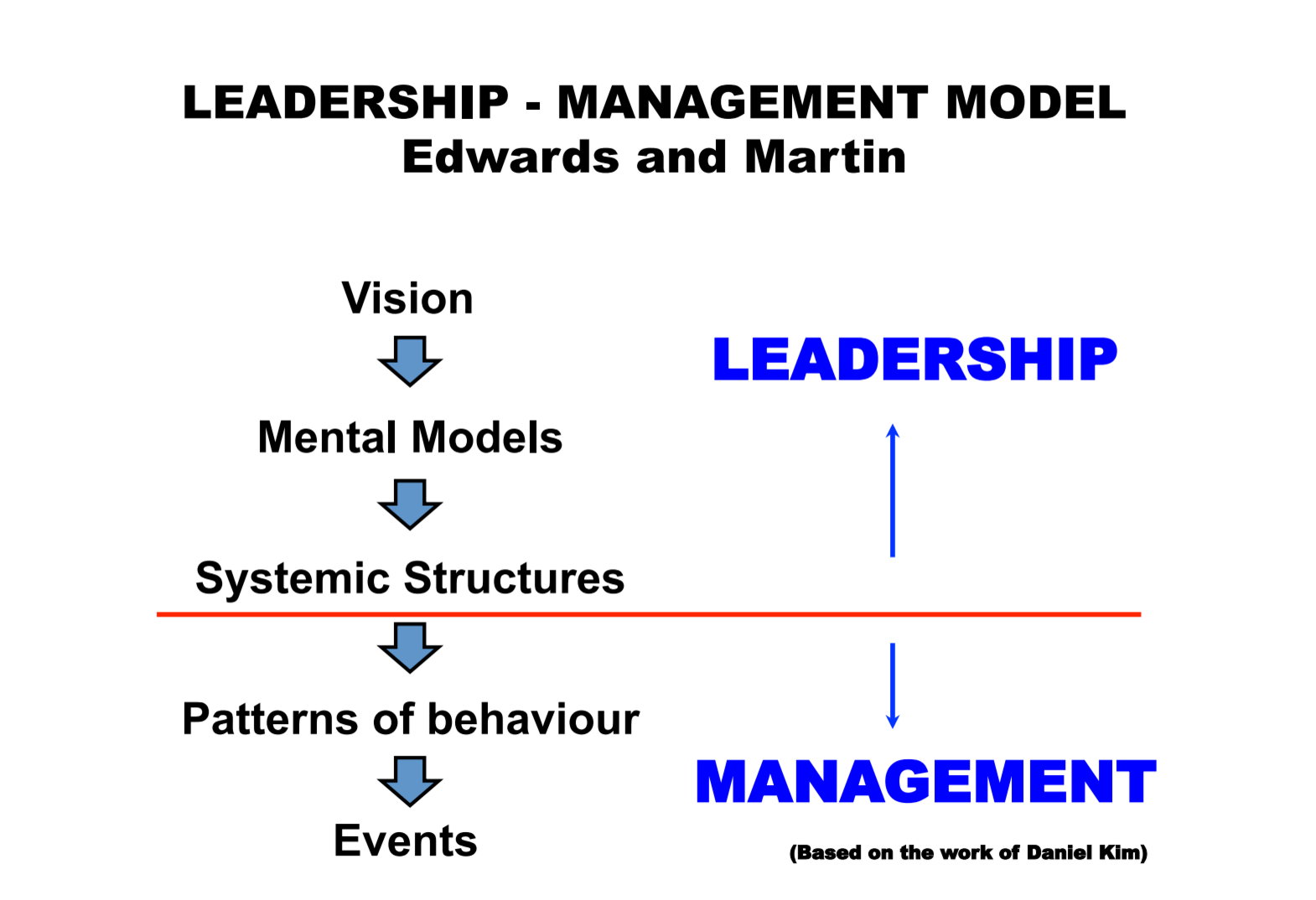
Leadership and Management Model
Make sure the systems and structures are aligned with the vision to be above the line. The higher up the levels of perspective (on the left of the slide) the more leverage we have. Values and beliefs need to become mental models for the vision to be lived.
This visioning process is a valuable, deep and respectful reflection tool. I look forward to utilising my learning from this experience in my own workplace and beyond.
Action without vision is only passing time, vision without action is merely daydreaming, but vision with action can change the world.